Monday, May 25, 2009
Further Traveling with Pharos -- the Traveler 127 reviewed
Posted by Don Tolson in "Pocket PC Hardware" @ 09:00 AM
Radios
As described in the specifications, the Traveler 127 certainly comes well equipped with all the expected connection capabilities (GSRM, GPS, BT and WiFi) through the Qualcomm chipset.
Cellular
The cellular radio provided in the Traveler 127 is truly world-capable, being able to handle both the European and North American data bands for 3G and UTMS transfers. I've never understood why other manufacturers (are you listening HTC?) feel the need to create specific units for the North American market. Maybe it has something to do with agreements with the cellular providers here.
As with most PDA phones these days, Pharos has included an automatic configuration routine for most cellular suppliers in North America. It was a nice surprise to see Rogers included in the list of supported providers and to see that the routines properly configured the data connections. Once everything was set up, I had no problem connecting into Rogers at E, 3G and H speeds. The Traveler 127 automatically upgraded the data connection as it found the coverage available. In contrast to other units I've tested, I didn't find the battery usage adversely affected by using the faster 3G and H data speeds at all.
The sound volume of calls through the front earpiece was a little on the low side for outdoors, but still quite useable. I suspect the vibration module is either badly placed or on the weak side, since even though I had the unit on ring and vibrate, I never really felt it when a call came in. I had problems with my custom-made MP3 ringtones, which work fine on other phones. They would either not play, or would only play one or two notes. The standard supplied ones work well though.
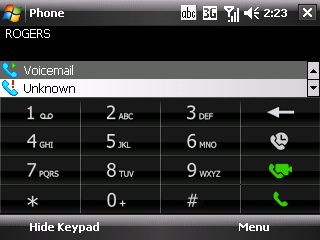
Figure 15: A screen shot of the phone dialer. The icons on the right are for call history, video calling, and regular voice call.
Bluetooth
The Bluetooth radio provided with the Traveler 127 is fully 2.0 compliant, with Enhanced Data Rate extensions. It was easily able to pair with my Helium Digital Headset, Motorola Stereo Headphones and the Handsfree unit in the Toyota Prius. All worked just fine and the range was similar to that of other units. I did find the volume through my Helium Digital BT headset was too loud. The headset was being overdriven, so voices were distorted and even the volume controls on the headset weren't sufficient to compensate.
WiFi
The 802.11b/g WiFi included in the Traveler 127 was a bit disappointing. While the range was fine, I could not get it to connect to my DLink 655 router through a WEP-PSK secured connection. It would see the router and ask for the key, but it would not connect. If security was turned off, it would connect immediately and it no problems with other unsecure network hotspots in local coffee shops and ski lodges. Unfortunately, I didn't have any other secured networks available to test it with to confirm it wasn't a problem with my router.
GPS
GPS and Navigation systems are where Pharos excels and they make sure that this part of their units works very well. It shows, as the Traveler 127 has one of the most sensitive and stable GPS units I've found in my testing. It's about on par with the one in the Pharos GPS600 unit they came out with a year or so ago. It can easily get a lock inside my house, away from the windows, in less than 20 seconds! And once it has the lock, it's rock solid. I took the T127 on a couple of extended (300km) trips up to the local ski mountain, and while I'll talk about the navigation software a little bit later, the GPS receiver did very well -- even in narrow mountain passes, where other systems get 'lost'.
Battery
The Traveler 127 comes equipped with a decent-sized 1410 mAh Lithium-Ion pack which is rechargeable and replaceable. While it's not as large as the HP910 Messenger, it did a reasonable job of powering the Traveler 127 over the two weeks of primary phone/PDA sevice I put it through. With what I would consider light use, it was able to run for about 2 days before it needed recharging, and would typically get back to full charge in about 3 to 4 hours.